
Parking optimisation: a Hesion customer shares their experience
Parking advice and support
As parking management specialists, we were approached by a major car manufacturer to help resolve parking management issues at a site with 10 000 spaces across 18 car parks.
The arrival of new employees on site had created a chaotic situation (unauthorised parking, entry by unauthorised vehicles, …), sometimes leading to clashes between users. It had therefore become essential to assess how access control, management and safety in the car parks needed to be reorganised.
How can car parks be reorganised to optimise parking?
To answer this question, we first sought to assess how well the site's parking provision matched user demand.
We were able to assess the site's capacity using the technologies we develop for our customers. These enabled us to measure occupancy and usage levels precisely across all the car parks. We also quantified the breakdown of parking spaces in each car park (electric vehicles, combustion-engine vehicles, accessible spaces…).
Demand was assessed using an effective questionnaire that took respondents less than 3 minutes to complete. Our teams surveyed 640 people to identify their habits and preferences.
And what were the results?
Cross-referencing the data enabled us to identify 3 areas for improvement in car park management:
- Balance usage across car parks
Car parks are unevenly occupied. This means that some car parks are in higher demand than others.
The survey shows that 50% of parking spaces are more sought-after than others.
This leads to unauthorised and sometimes obstructive parking, which can provoke aggressive reactions from users frustrated by the situation.
- Encourage carpooling
Balancing occupancy across all car parks helps ease a situation that has become contentious, but does not provide the flexibility needed to accommodate fluctuations in the number of users visiting the technical centre each day.
One way to achieve this is to encourage users to carpool.
Our survey shows that 20% of users who do not currently carpool would do so if a collaborative app were available to them. This represents 1500 spaces, a gain of more than 15% of total parking capacity.
- Rebalance parking supply and demand
Finally, the survey also identified a 1% gap between parking supply and demand for combustion-engine and electric vehicles.
This seemingly small gap becomes significant when expressed in numbers of spaces.
There are currently 100 unused electric vehicle spaces and a shortage of 100 spaces for combustion-engine vehicles. Adjusting the allocation of these parking spaces would balance parking supply, meaning the number of available spaces, with demand, meaning the number of vehicles.
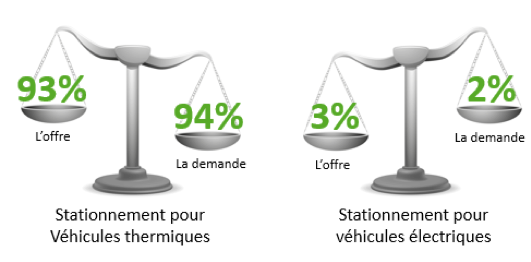
Breakdown of supply and demand for available parking spaces at our client's site by vehicle type
Because we support our clients throughout their parking transformation process, we provide the tools they need to implement our recommendations. These may involve rebalancing parking occupancy or introducing new parking rules to free up spaces.
Based on our survey, we estimate that our recommendations could free up 500 to 1500 spaces, or 5% to 15% of the car park's capacity.
And what does the client think?
“We have been using Hesion's services for more than 12 years and have built a genuine relationship of trust.
Our partnership is built on high-quality services and solutions consistently tailored to our needs.
Hesion manages the operations of our five technical sites in Île-de-France on our behalf.
This allows us to focus fully on our core business.”
Testimonial from Florent Pruvost,
Head of Reception, Prevention and Protection for the Île-de-France sites.
As a French specialist in Smart Parking solutions, Hesion can support you with all your car park access and parking management challenges. Please contact us with any questions.
← All parking news